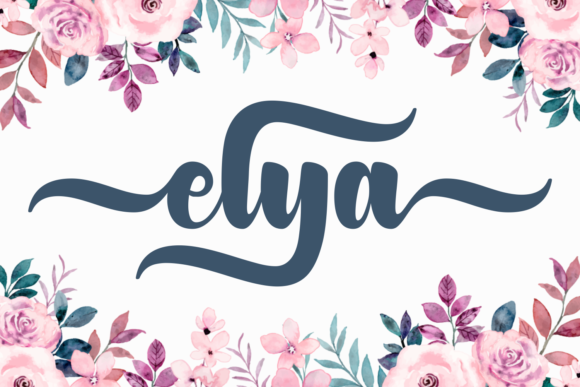
Elya: A Beautiful Display Font for Elegant Branding
Two weeks ago, I sat at my kitchen table with a stack of blank candle labels, a half-finished Canva template, and that familiar “something’s missing” feeling. My small-batch soy candle business had grown steadily—local boutiques carrying my scents, repeat customers tagging me on Instagram—but the visuals still looked… pieced together. The font on my jar labels clashed with my website headers, and my wedding-themed gift boxes used three different scripts just to get one cohesive look. That’s when I searched “beautiful display font for wedding invitations”—and found Elya.
Elya for Wedding Invitations and Elegant Branding
Elya is more than just a pretty display font. It’s got that soft confidence—elegant ligatures that flow like inked calligraphy, thoughtful alternates that let you fine-tune charm without overthinking, and a modern touch that keeps it from feeling dated or overly formal. As a small business owner who regularly designs thank-you cards, gift tags, and limited-edition packaging for weddings and engagements, I needed a font that felt personal but polished. Elya delivered: one consistent voice across printed invites, digital RSVPs, and even Instagram Story highlights. It doesn’t shout—it invites. And that subtle shift changed how customers described my brand: “refined,” “thoughtful,” “the kind of detail I notice.”
Elya for Candle Labels and Handmade Product Packaging
I swapped out my old label font for Elya on our lavender-vanilla jar sleeves—and instantly, the product felt more intentional. Because Elya is a display font, it shines best in short, high-impact moments: scent names (“Midnight Jasmine”), collection titles (“Seasonal Edit”), and signature lines (“Hand-poured in Portland”). It’s not meant for ingredient lists or legal disclaimers (that’s where a clean sans serif comes in), but for those first 3 seconds when someone picks up your product. On matte kraft paper? Gorgeous. On glossy sticker stock? Crisp and luxurious. Just make sure you’re using the OpenType features—those elegant ligatures activate automatically in design apps like Illustrator or Affinity Designer, adding quiet sophistication with zero extra work.
Elya for Café Menus and Local Business Signage
A friend who runs a cozy neighborhood café asked me to help refresh her chalkboard-style menu board. She’d been using a free handwritten font that looked charming at first—but under fluorescent lights, the thin strokes vanished, and the spacing felt uneven. We tried Elya for section headers (“Pastries,” “Specialty Drinks,” “Local Favorites”) paired with a friendly, legible sans serif for descriptions. The result? Warmer, more inviting, and surprisingly easy to read—even from across the room. As a display font, Elya works beautifully at larger sizes on printed menus, vinyl decals, and digital kiosks. Just avoid scaling it too small: under 18pt on printed materials or under 24px on screens, some of its delicate details soften. Save it for where it sings—headlines, banners, and branded accents.
Elya for Social Media Graphics and Digital Ads
If you’ve ever spent 20 minutes trying to make an Instagram carousel feel “on-brand,” you’ll appreciate how Elya cuts through visual noise. I use it for quote graphics (“Slow down. Breathe. Light a candle.”), limited-time offer banners (“Spring Restock — Live Now”), and even watermark-style logo treatments in Reels thumbnails. Because Elya is a premium font, it stands out against generic system fonts—and feels unmistakably *yours*. Bonus: its alternate characters let me rotate between two versions of “A” or “S” across posts, keeping things fresh without sacrificing consistency. For digital use, always export as PNG or JPG with crisp anti-aliasing—not SVG text—so those elegant curves render cleanly on every device.
Elya for Logo Design and Small Business Brand Identity
Your logo is often the first thing people remember—and the last thing they forget. When I redesigned my candle brand’s wordmark, I tested dozens of fonts, but only Elya gave me that rare balance: distinctive enough to stand alone, graceful enough to pair with photography, and versatile enough to scale from a tiny website favicon to a large shop window decal. As a display font, it’s not built for long paragraphs—but it *is* built for presence. I paired it with a light-weight geometric sans serif for supporting text (think: tagline, contact info, website URL), and suddenly, everything clicked: business cards, email headers, packaging tape seals—they all felt like part of one thoughtful system.
Elya Fonts File Support and Commercial Licensing Tips
Before downloading any font, I always check three things: file formats (OTF and TTF included? Yes—Elya delivers both), commercial licensing (yes—it covers physical products, digital templates, client work, and online shops), and language support (it includes Latin-based languages and common diacritics—perfect for names like “José” or “Naïve”). I also opened the font file in Font Book to preview all alternates and ligatures—there are over a dozen built-in options, accessible via the Glyphs panel. No need to install multiple files or hunt for “stylistic sets.” Everything lives neatly inside one display font package. And because it’s well-hinted, it renders smoothly across platforms—from Canva to Adobe Express to Cricut Design Space.
Elya for Thank-You Cards and Customer Experience Touchpoints
The little things build loyalty. A handwritten note feels special—but not everyone has time to write 50 notes per week. So I designed a simple thank-you card template using Elya for the opening line (“Thank you for lighting up our day”) and a clean sans serif for the rest. Printed on textured cotton paper, it landed differently—warmer, more human, more memorable. Customers started mentioning it in reviews: “The packaging *and* the note made me feel seen.” That’s the quiet power of choosing the right font: it turns functional communication into emotional connection. And Elya, with its elegant ligature and alternative options, makes that easy—no design degree required.